Update: Flying a kite inside the maze

I’m in the middle of writing my new book and I love it. There’s no feeling quite like that of being lost inside its world. It’s the desperate, delicious, absorbing pleasure of reading – characters and setting and plot that come to life inside your mind so that you need to turn Just. One. More. Page – but a thousand times better. (It can also, occasionally, be a barren desert of a place, but that’s a discussion for another time.)

All writers write differently, and I was asked recently whether my own process mirrors that of either of my two writer sisters in The Distant Hours.

(A quick refresher, Saffy and Juniper are two of the three Sisters Blythe. They both write, but where Saffy is methodical, reading, writing, drafting and re-drafting, collecting all her edits in pretty paper-covered boxes, Juniper is the archetypal artist, leaving scattered pieces of scrap paper in her wake as she seizes upon one idea after another, ‘writing herself free of entanglement’.)

My own experience sits somewhere between the approaches of my two characters. I love to plot and plan in the beginning; the process gives me enormous pleasure and purpose. But once the story is underway, even though I continue to fill my notebook with ideas and scene breakdowns, there’s a momentum that arrives. I liken it sometimes to flying a kite: at first it’s hard work, and you have to put in a lot of effort, dragging the heavy, unwieldy object along the ground behind you; but then, at some magical, wonderful point, enough wind and speed has amassed beneath it, and up it goes, flying by itself.

When the kite is up and I’m ‘inside’ a book, I relate completely to the idea of having to write myself free of entanglement. It’s like being stuck within a maze, which makes it sound trapping, which it isn’t; rather, it’s all-encompassing. I become stuck within the maze of the story and for as long as it takes me to reach the exit, no matter what else is happening in my Real Life, the characters, their plot, their settings, are in my mind. It can be frazzling at times, but I can’t imagine not having them there. In fact, when I’m not working on a book I feel restless and, ahem, I’ve been told that I become rather tetchy.

I had an incredibly wise and generous drama teacher when I was growing up. His name was Herbert Davies and Edie’s Herbert in The Distant Hours is based on him (in spirit. There are a number of differences in their biographies). He was seventy when I met him and over the next couple of decades he became a great friend and mentor to me. He’d been the Head of Radio Drama for the Welsh BBC, he’d served in Burma in the Second World War, and he’d been part of that set of incredible Welsh poets and actors including Dylan Thomas, Rachel Roberts, and Richard Burton. Herbert used to tell me there were two ways to approach acting, with intellect or with instinct, and that the very best actors, were those who were able to combine both. Writing, it has always seemed to me, is very much the same


Update: Flying a kite inside the maze2020-02-09T10:01:09+00:00

Update: How do I love thee, notebook?

A while back I did an interview with Historical Novels Review. The journalist and I live in different cities, so the interview was conducted via email. This happens sometimes and it’s actually my preferred mode of Q&A, not because I’m anti-social (well, maybe just a little bit), but because I always feel more comfortable expressing myself in writing than I do out loud.

The Distant Hours-crop-325x325The list of questions when they arrived excited me. This isn’t always the case with Q&As, and the reasons were twofold: first, they were things I hadn’t been asked before (always a good start); and second, they were about the process of writing, which is far more interesting to talk about than myself. In particular, they were about how much – or little – my own experience of writing compares with that of my characters in The Distant Hours.

The first question was about notebooks, a subject dear to my heart.

HNR: Whether in a muniment room with dead man’s notebooks; taking a sneaky read of a sister’s journal; finding the courage to write on the crisp new pages of a new journal; or while sitting in a quiet place with writing materials and a strong cup of tea, the notebook is a strong feature of all your writer’s lives. Can you tell me now this works for you? Are you a notebook person? If yes, what do you write in your notebook? Information? ‘Everything you see and think and feel?’ Or do you carefully craft scenes, ‘reading aloud and relishing the pleasure of bringing your heroine’s world to life?’  

KM: I am absolutely a notebook person. To imagine being without one fills me with dread. (I only keep notebooks for story-writing though, and I’ve never been able to stick to keeping a diary.) By the time I finish writing a novel, I’ve usually gathered around ten notebooks of story ideas, random images, plot schematics, scene details, graphs, snatches of overheard conversation. . . you name it, it’s in there. Scribbled, crossed-out, connected with arrows, stapled in on top of other bits and pieces. Quite a mess, but a somehow lovely one. I’m a visual person and to see them sketched out in my notebook helps me to clarify my thoughts and pin down my ideas. Also, the pen in hand forces me to focus.

I have a great fondness for stationery in general and I take enormous pleasure in selecting a new notebook at the beginning of each project. The feel of the paper, the thickness of the cover, the colour and spacing of the lines inside. (Although, I’ll work with whatever I’ve got when the ideas start coming, the backs of old envelopes included.)

When I was about a quarter of the way into House at Riverton I lost a notebook. I’d left it on the roof of my car when I strapped in my small person, and then forgotten to collect it and driven away. As soon as I arrived at my destination and couldn’t find it, I knew what must have happened. I drove back along the same route, heart in my mouth, but there was no sign. I letter-box dropped, door-knocked, walked the streets, offered a reward: all to no avail. I wonder sometimes, how different (or not) the story might have been had I found the old notebook with its chapters plotted out.

It was an awful experience, but it taught me that no matter how essential the notebook seems at the time, no matter how tightly I cling to it when I’m dreaming up a story, a novel is a living, breathing organism and will continue to grow – perhaps in even more propitious ways than those sketched out – without it. There are always more ideas and new ways of tying them together, and the unconscious mind is a powerful thing—it doesn’t need a notebook to keep hold of the really important ideas.

Update: How do I love thee, notebook?2020-02-07T17:02:02+00:00

Video: The Distant Hours trailer, by Andersen M

I am inspired by artists of all kind, and their unique and wonderful forms of creative expression. It was an absolute thrill to see what the London-based team at Andersen M Studio came up with in response to my novel, The Distant Hours, in late 2010. Eerie, elegant, haunting, and beautiful. I still have one of the miniature paper-cut castles on my desk, where I can see it when I work.

Not only did Andersen M create this brilliant trailer, they also outfitted the (then) new Pan Macmillan HQ in King’s Cross, London.

Video: The Distant Hours trailer, by Andersen M2024-04-11T03:49:08+01:00

Video: Kate Morton at the Wheeler Centre, Melbourne

In early November, 2010, I had the pleasure of speaking with Blanche Clark at the Wheeler Centre, Melbourne, ahead of the publication in Australia, and around the world, of my third novel, The Distant Hours.

Some of the topics we covered include the writing process, research, the power of history, how to write with small children, and my mentor Herbert Davies. I also read the opening segment from The Distant Hours, in which Edie Burchill discovers a letter addressed to her mother, lost and undelivered for many years.

Video: Kate Morton at the Wheeler Centre, Melbourne2024-04-11T02:38:23+01:00

Update: An unexpected collaboration.

I think I might have mentioned the shiny first editions that have started arriving at my door? Gorgeous covers, thick powdery pages (oh, so many pages!), and the most glorious endpapers you’ve ever seen. This divine image from the front of the UK edition made me cry when I first glimpsed it, and I’m not an easy-crier. The artist has actually made real Juniper’s lost letter: there’s an historically accurate stamp, a proper postmark, and don’t even get me started on the scratchy handwriting and little mouse nibble at the bottom.

kids drawingThere has been much stroking of said covers, much gazing at endpapers and an awful lot of page sniffing going on around here. Which is probably why it struck me so hard when I opened the door to my office this morning and found my two year old, who had been out of sight no more than a minute, standing at my desk with his red felt pen poised.

There is a lot of clutter on my desk. I am not a neat worker. There were any number of things on which he might have chosen to focus his attention. He chose my newest arrival and augmented it thus. This is the dedication page. I’m not going to show you the endpapers. Or the cover. Suffice it to say, they have also been amended.

It is our first collaboration and, although unexpected, I think he has a point. What isn’t improved with a bold splash of red? (And, I’m sure you’ll agree, for a two year old he draws a mean circle.)

I think I will put the book away somewhere safe and give it to him one day when he’s all grown up and has long forgotten his fondness for covering every unsuspecting surface with circles.

Update: An unexpected collaboration.2020-02-07T17:34:31+00:00

Update: On finishing a book

The Distant Hours is done, which means that I’m back in the real world and it feels wonderful. That is, it does now. It didn’t immediately.

The final period of a book’s creation is such a dense, busy, all-encompassing place to be, that when the final pages are finally wrested away and sent to the printer, there comes an inevitable slump. A hole. A gap. A nervy, tic-inducing period in which people say things like, ‘you must be so pleased’, and, ‘now it’s time to relax’, and although you smile and nod, what you really want to whimper is, ‘but I miss them all so much. I miss being in the Middle of Things.’

It doesn’t last forever (the new characters and stories are too determined to let that happen), but it’s a dazing and distancing time, characterised by a strange sense of something that feels a lot like loss. I find myself standing in my office, aimlessly surfing my computer, rearranging my desk, flicking through my research books, and feeling oddly unsettled.

Then the ARCs go out, the first editions arrive at my door, and slowly, slowly, a few eager, early books begin to find their way to readers.

And that’s when the sense of being untethered starts to disappear. Because no matter how much I adore writing, no matter the pleasure my stories give me, it isn’t until books are read that they really start to breathe.

Update: On finishing a book2020-02-09T09:57:47+00:00

Thought: Memory musings, new books, and useful personal grooming tips

I was contacting my six-year-old son’s schoolbooks over the weekend and by complete coincidence my mum arrived with an enormous sack of musty, dusty old books that had been mine when I was around the same age. They’d turned up in a cupboard on Tamborine Mountain and she thought that I should have them.

There were a number of things inside that sack that I’d completely forgotten: it may interest you to know, for instance, that my social studies scrapbook from the mid 1980s contains a brief unit on ‘Head lice and how to get rid of them’, complete with a six step illustrated guide. For your edification, step two, ‘Use special shampoo twice in one week’, is underlined, so I gather that part’s rather important. Such useful personal grooming tips can be found sprinkled amongst units as diverse as ‘How to make a light bulb light up’ and ‘I could help a disabled person this way’. I’ve listed ten ways to help disabled people, but I’ve asterisked and underlined number seven, ‘Be Nice.’ Which seems like pretty good advice when dealing with people in general.

I couldn’t help wondering how my dad felt about the little essay I wrote about him:

“My father’s name is Warren. He is about forty-six years old. [Dad was 34 at the time.] He is an engineer. He likes beer, picnics, and watching the news.”

It’s illustrated, and he’s looking up from the television set to smile. The teacher has given me a ‘Very Good’ stamp and added, ‘Well written! Neat work!’ I have made a mental note to check my son’s parental essays before they go back to school for marking (of him) and judgement (of me).

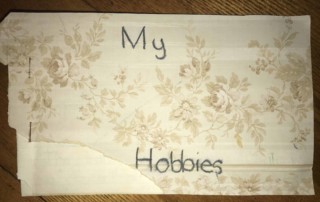
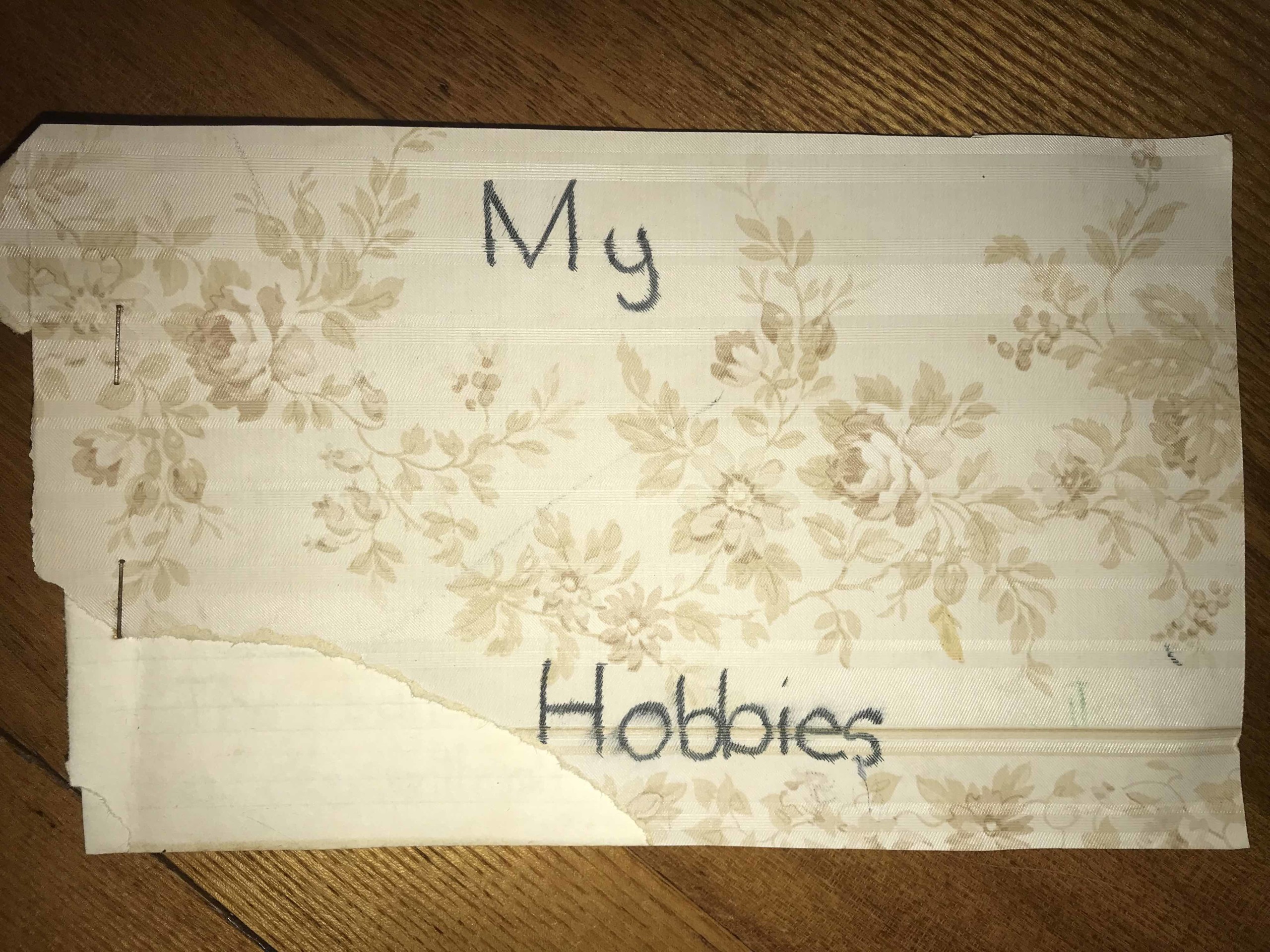
My favourite find was a little book, hand-cut and stapled by the teacher, its cover made from brown swirly floral wallpaper, circa 1979. I remember being rather awed by that wallpaper cover: it had a lustre to it back then, so the brown was almost golden. The passing decades have stripped it to matte, but I still felt an echo of reverence as I held it in my hands. We were not a wallpaper family, and I always felt a bit envious of those who were. On the front of my special book, I’ve printed the title ‘My Hobbies’, and inside, in very careful handwriting, I’ve written that my hobby is being a ballerina and then outlined in great detail the times and days that I attend ballet lessons. And clarinet lessons. And then the possible contingencies in case I couldn’t make one of those lessons and needed to make it up.

On the final page, I came across the following:

As I went through those books, alongside the things that had slipped my memory completely, were certain pages I remembered vividly. As in, where I’d been sitting when I’d worked on them, mistakes I’d made and how I felt about them, bits that made me proud. The distance between now and then was missing, somehow, and I was able, almost, to reach out and touch my seven-year-old self. I don’t need much urging to think about memory and the way it ties us to the past, and I’ve been wondering what it is about some experiences that makes them so easily retrievable. Traumatic or exciting events I can understand: but why remember the moment spent sitting at the kitchen bench, eating sultanas and shading around the illustration of a girl having her hair combed for lice, when so many other similar moments are lost?

And, when I’d returned to covering school books, and I was doing that thing with the ruler that gets the bubbles out of the contact, I had the happy-but-also-melancholy wondering as to whether my son, decades from now, will pull out the notebooks that his mum covered for him, dust them off, and turn their pages once more. What will he have written or drawn inside? Will he look back at the copious drawings of A380 planes and remember his dream of being a pilot? Will he perhaps be a pilot? And will there be certain pages that draw him, as if by a thread, back to the moment when he sat, six years old, in a damp classroom, and the days seemed to stretch eternally, and his lunch was waiting for him in his bag, and the future seemed endless? I hope so.

Brisbane, 2010

Thought: Memory musings, new books, and useful personal grooming tips2020-05-27T06:41:11+01:00
Go to Top